


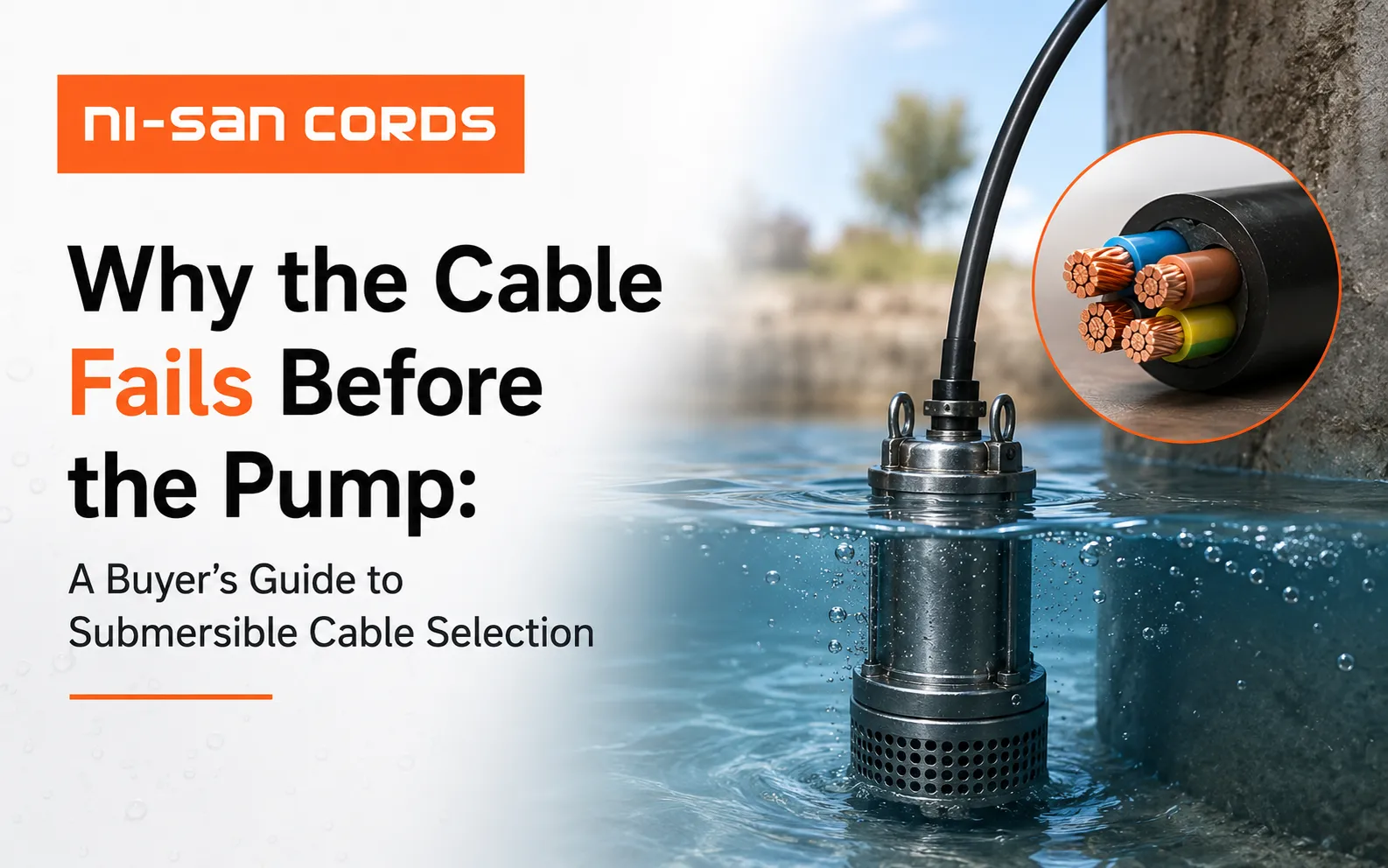
A well-designed submersible pump can still fail because of its cable. Long runs, water, tight borewell space and weak joints test the whole cable. The product range at nisancords.com includes flat and round submersible pump cables for bulk OEM needs, but the final choice must follow the pump, depth and site.
Start with the Pump, Panel and Total Length
Motor power alone is not enough to size a cable. The buyer should share rated voltage, full-load current, starting method, duty, panel location and complete route from panel to motor. The length above ground also counts.
As the cable grows longer, resistance creates voltage drop. Too much drop can reduce starting torque, raise current and add heat. The BIS testing scope for submersible pump sets refers to a limit of three per cent between the control panel and motor terminal. The design team must check cable size for the approved pump.
The 2025 Central Ground Water Board assessment put annual extraction at 247.22 billion cubic metres. It also placed the extraction stage at 60.63 per cent. With pumps serving farms, homes and industry across varied depths, cable selection has a role in reliable water movement.
Flat and Round Cables Solve Different Fitting Needs
Flat cables place the cores side by side. Their slim shape can fit the narrow space between a borewell casing and pump assembly. They can also be tied neatly along a rising pipe.
Round cables group the cores within a circular outer form. They may suit open-well pumps and routes where a round shape is easier to seal. Neither shape is better in all cases. Pump design, available clearance, gland, joint and route should decide.
Buyers comparing submersible cable manufacturers in India should provide the required shape, number of cores, conductor size, length, monthly volume and approved sample or drawing.
Water Resistance Depends on the Whole Build
The cable may stay under water, but water is not the only risk. Abrasion during lowering, sharp edges, oil near the panel, sunlight above ground and pulling stress can damage the sheath.
Check conductor quality, insulation grade, sheath thickness and adhesion between layers. Ask how spark, high-voltage, insulation-resistance and dimensional tests are controlled. A smooth outer finish cannot prove electrical strength.
Treat Every Joint as a Risk Point
A poor cable joint can let water reach the motor. The joint should be planned, not left to a quick site repair. IS 8034 requires the motor maker to provide a detailed watertight jointing process when the motor lead joins the user’s cable.
Use the approved joint kit and trained staff. Keep the joint away from strain where possible. Check sealing, insulation and continuity before lowering the pump. A weak splice can undo the value of a sound cable.
Control Repeat Orders
The purchase order should state shape, size, core colours, print, coil length, tolerance, packing and test papers. Fix the approved drawing or sealed sample. Check cable length, as a short supply can force an unwanted site joint.
Ni-San states that it makes flat and round submersible cables with in-house drawing, bunching, PVC compounding, extrusion and testing. Buyers should still approve each build against the pump and field conditions. The right cable is not merely waterproof; it must carry the load, limit voltage drop, survive installation and remain consistent across repeat batches.